
Craft, Gaudí and Barcelona
Trencadís: From Gaudí’s Ingenuity to Gal Hart’s Contemporary Mosaic Art
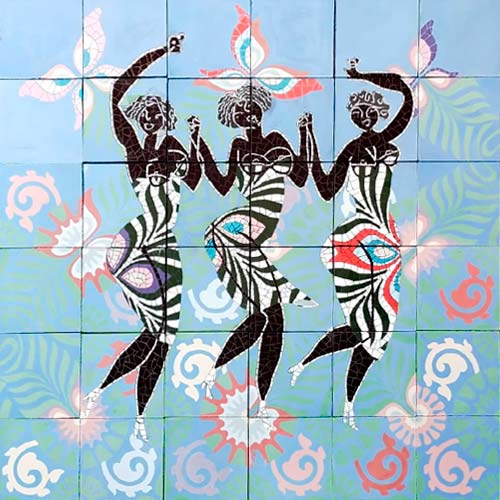
A journey from Barcelona in 1900 to contemporary mosaic studios.
When necessity became art
A fascination with curves and the birth of a technique
Look closely at nature and straight lines seem to disappear. Antoni Gaudí believed architecture should learn from natural forms, yet faced a very practical problem at the end of the nineteenth century: how could rigid, flat ceramic tiles cover curved, undulating, organic surfaces?
The answer was as practical as it was ingenious: break them into pieces.
Trencadís (from the Catalan trencat, meaning “broken”) did not emerge simply as a decorative choice. It was also a functional solution. By breaking tiles, plates and bottles into fragments, Gaudí could create a flexible ceramic skin that followed the unusual shapes of Casa Batlló, Park Güell and the Sagrada Família, among other buildings.
“The straight line belongs to men, the curved one to God.” — A quotation commonly attributed to Antoni Gaudí.
At Petit Gaudí, we carry the idea of trencadís into wood. With the 26 movable pieces of the Trencadís 5-in-1 Puzzle, you can assemble a mosaic and experiment with your own compositions.
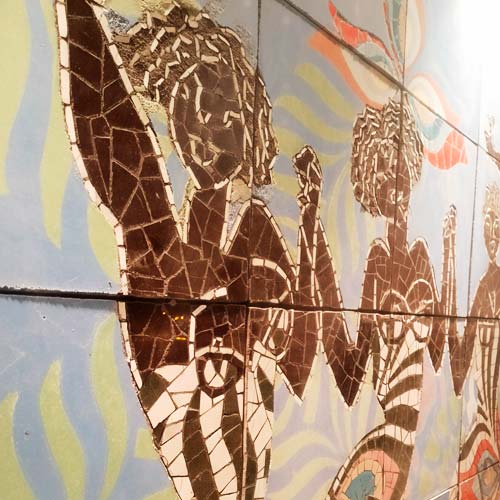
Recycling, light and Jujol’s hand
Long before people spoke of “sustainability” or upcycling, Gaudí and his close collaborator Josep Maria Jujol were already exploring the reuse of materials.
Rather than seeking flawless new tiles, they turned to discarded or imperfect ceramics, including material associated with the Pujol i Bausis factory in Esplugues de Llobregat. This approach brought three important qualities:
- Economy and material reuse: broken crockery, glass and ceramic fragments could be given a new purpose.
- Durability: glazed ceramics stand up well to rain, sunshine and the passage of time.
- Play of light: fragments set at slightly different angles catch and reflect light differently throughout the day, giving the surface a vibrant, almost impressionist quality.
Although Gaudí was the architect, Jujol often played a decisive part in the colour and visual rhythm. His way of composing with ceramic fragments resembles painting with colour rather than applying a regular tiled pattern.
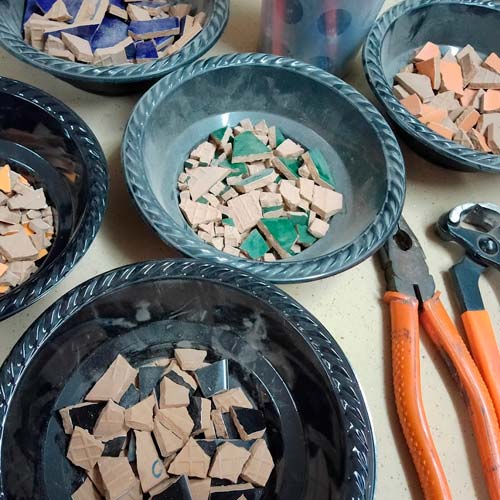
The technique today
How has Modernista mosaic evolved?
For decades, trencadís was primarily associated with architectural exteriors. In the twenty-first century, however, mosaic has moved beyond buildings and entered interior design and fine art.
The technique has developed in several directions:
- From cement to modern adhesives: finer, lighter work has become possible.
- From façade to canvas: contemporary artists bring trencadís into paintings, mirrors and sculptures for interior spaces.
- From discarded fragments to precious materials: artists also work with special glass, Venetian smalti and ceramics made by specialist makers.
The historical reference remains important: the ceramic surfaces of Park Güell show how colour, material and architecture can work together.
A conversation across time
A detail from Hart Mosaics: subtle gradients, precise cutting and an artistic rather than purely architectural use of mosaic.
A contemporary master
Gal Hart: precision within apparent chaos
To see how Gaudí’s legacy remains alive today, we can look at artists such as Gal Hart.
From his studio, Hart Mosaics, Gal has reinterpreted the philosophy of trencadís for contemporary art. If Gaudí explored mosaic on an architectural scale, Hart focuses on precision at the level of each fragment.
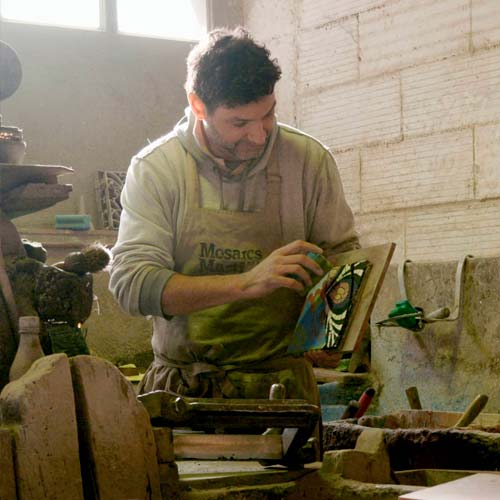
His work connects with the Catalan master in two particularly important ways:
- Andamento, or visual flow: as in Park Güell, fragments follow directional lines that guide the viewer’s eye and create movement within a static image.
- Respect for the material: every fragment is cut and positioned with purpose, allowing light to interact with colour.
- A different scale and function: whereas Gaudí used ceramic surfaces as part of buildings, Hart develops mosaics as artworks for contemporary spaces.
Take part in twenty-first-century trencadís
Are you fascinated by the visual language of mosaics? You can explore the contemporary development of this technique through the current work of Hart Mosaics.